Every Taylor Swift Quiz Tests One Skill. This One Tests Two.
The fandom's oldest argument is about what a Taylor Swift quiz should even measure, and it has never once been settled by taking one — because they all measure the same thing: whether you can match a song to an album.
There are two camps. The first says a real Swiftie knows the catalogue cold: that Speak Now has no co-writers, that 1989 is her birth year, that Midnights put her in all ten of the Hot 100's top slots in a single week. Facts. Checkable. The second camp calls that trivia and nothing more. Real fluency, they argue, is decoding — knowing track five will hurt before you press play, catching William Bowery in the credits, reading a sixteen-hour album announcement as a statement about the music industry rather than a marketing stunt.
This quiz refuses to pick a side. It scores both, separately: thirteen recall questions and seven decode questions, walked forward through five eras in order. The gap between your two numbers tells you far more about how you listen than one score out of twenty ever could.
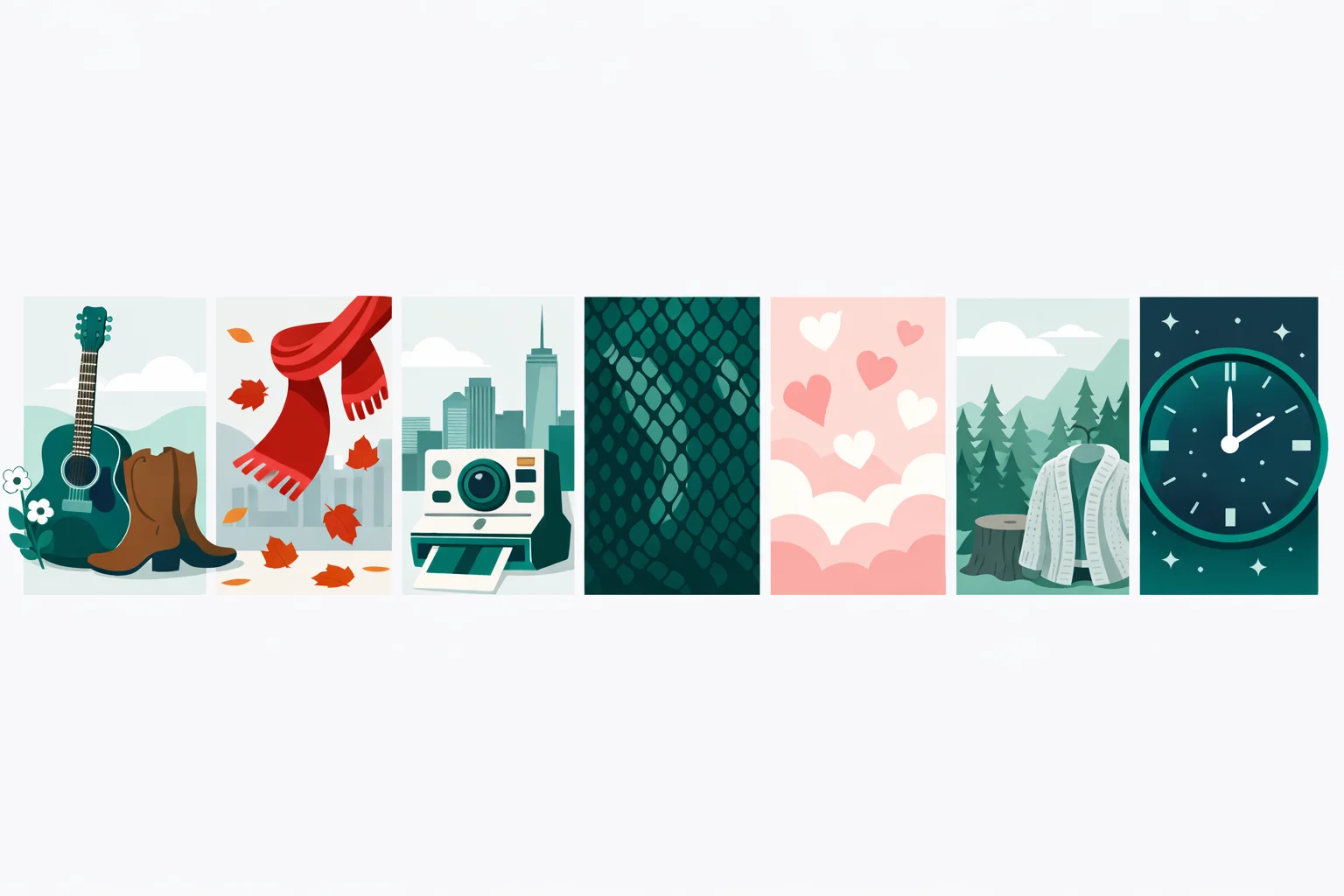
The Case for the Recall Camp
Here's the strongest version of the recall argument: no other pop career of the last twenty years is this dense with checkable numbers, and you genuinely cannot discuss it without them.
Four Album of the Year Grammys — Fearless in 2010, 1989 in 2016, folklore in 2021, Midnights in 2024 — a total no artist had ever reached. Twelve studio albums plus four released Taylor's Versions, which means even the release order is a non-trivial thing to hold in your head. The entire Hot 100 top ten occupied simultaneously in November 2022. The Eras Tour running 149 shows from March 2023 to December 2024 and becoming the first tour in history to gross more than two billion dollars.
Those aren't collector's facts. They're the shared vocabulary of the fandom, and someone who can't place Lover relative to reputation is missing the shape of the story, not just its footnotes. Recall is also the only axis that transfers: if you enjoy this kind of chronological memory work, our Name That Song Quiz runs the same skill across seven decades of music instead of one artist.
But the Decoders Have One Unbeatable Argument
She taught them how.
On her first four albums, the lyric booklets used seemingly random capital letters that spelled out a hidden sentence for each song. That was not a fan invention or a coincidence anyone stumbled onto — it was printed in the packaging, on purpose, by an artist who has repeatedly described planting clues months and sometimes years ahead of a release. The close-reading habit this fandom is mocked for is authored. It was designed into the product.
That makes Swift genuinely unusual, and it's the thing most Taylor Swift trivia quizzes miss entirely. Plenty of artists have fandoms that read too much into everything, developing that instinct in spite of the artist. Very few have spent eighteen years actively training an audience to check the credits, count the letters, and treat a track number as information. A fandom that cracked the William Bowery pseudonym before it was publicly confirmed wasn't being obsessive — it was doing exactly what the liner notes had spent a decade teaching it to do.
It's also why misheard-lyric questions belong on the decode axis rather than filed under fun. "Lonely Starbucks lovers" became a running joke precisely because this is a fandom that listens at the level of the individual word. Get that question wrong and you learn something real about how you consume her music: you hear songs, not lines.
Why This Quiz Scores You on Two Axes, Not One
So the quiz is built to measure both claims and let your own answers arbitrate. Twenty questions, five acts of four, arranged chronologically from the 2006 debut to the 2025 masters buyback. Thirteen questions test recall. Seven test decoding. Each question carries a visible badge telling you which, because knowing a different skill is on trial changes how you think about the answer.
The chronological ordering is deliberate and it's the main thing that separates this from a shuffled Taylor Swift era quiz. Her sound changes so sharply between eras that a randomised question order measures almost nothing: a 1989-era fan and a folklore-era fan can post identical totals while getting completely different questions right. Five separate bracelets, one per era, show where your knowledge actually lives — and an empty bracelet is far more useful information than a middling total.
The two-axis result is the part worth sitting with. High recall with low decoding is by far the most common shape, and it means you absorbed the career from being online: headlines teach dates and chart records, they never teach credits. The reverse pattern — strong decoding, weak recall — usually belongs to someone who came in through the writing, went deep on two albums, and never learned the chronology. Both are real fandom. They're just not the same thing, and a single score out of twenty hides the difference.
Every Era, and the Fact Each Act Is Built Around
Each act is anchored to one fact that separates people who lived through that era from people who arrived later. If you want to know where your gaps are before you even take the quiz, read the last column.
| Act | Era | Albums | Years | The fact most people miss |
|---|---|---|---|---|
| I | Country Roots | Taylor Swift, Fearless, Speak Now | 2006–2010 | Speak Now has zero co-writers — all 14 tracks are hers alone |
| II | The Pop Pivot | Red, 1989 | 2012–2015 | 1989's 2016 Grammy made her the first woman with two Album of the Year wins |
| III | Snakes and Pastels | reputation, Lover | 2017–2019 | Lover was the first album whose master recordings she owned outright |
| IV | Into the Woods | folklore, evermore | 2020 | folklore arrived with roughly sixteen hours' notice |
| V | The Vault Era | Midnights, The Tortured Poets Department, The Life of a Showgirl | 2022–2025 | Midnights held all ten Hot 100 top-ten spots at the same time |
Notice how unevenly those eras are weighted in the culture. Act V dominates streaming, so newer fans clear it easily and then hit a wall at Act I, where the country years get almost no play. Long-time fans do the reverse. Act III is the genuine equaliser: two of its four questions live in the songwriting credits rather than the songs, and the "Look What You Made Me Do" interpolation catches nearly everyone.
Track 5 Is Not a Coincidence
Read this list top to bottom before you decide the fandom reads too much into things:
| Album | Track 5 |
|---|---|
| Taylor Swift (2006) | Cold As You |
| Fearless (2008) | White Horse |
| Speak Now (2010) | Dear John |
| Red (2012) | All Too Well |
| 1989 (2014) | All You Had to Do Was Stay |
| reputation (2017) | Delicate |
| Lover (2019) | The Archer |
| folklore (2020) | my tears ricochet |
| evermore (2020) | tolerate it |
| Midnights (2022) | You're on Your Own, Kid |
| The Tortured Poets Department (2024) | So Long, London |
Eleven albums, eleven of the most emotionally exposed songs on each of them, all sitting in the same slot. Swift has acknowledged the placement is intentional, which did something unusual: it converted a fan theory into a stated convention. Fans now routinely play track five first on release day — a listening behaviour an artist created on purpose.
This is the single best illustration of why the decode axis exists. No amount of chart knowledge gets you to track five. You either noticed the pattern or you didn't, and noticing it is a skill that improves the more of her catalogue you read rather than stream. The same logic applies to fandom naming conventions elsewhere in pop — our K-Pop Quiz is built on the same premise, where its hardest question turns out to be about Korean contract law rather than a song.
What Actually Happened With the Masters
This is the most misunderstood stretch of her career, and it's the reason two questions in the quiz look like business trivia. The short version, in order:
She signed with Big Machine Records — a small Nashville independent — at fifteen. Like almost every new artist deal, it gave the label ownership of the master recordings for her first six albums. In late 2018 she left for Republic Records, negotiating ownership of all future masters, which is precisely why Lover in 2019 is the dividing line in her catalogue.
In June 2019, Scooter Braun's Ithaca Holdings bought Big Machine, masters included. A very public dispute followed, and in November 2020 those masters were sold on again, to the investment firm Shamrock Capital. Her response was the re-recording project: Fearless (Taylor's Version) in April 2021, Red (Taylor's Version) that November, Speak Now (Taylor's Version) in July 2023, and 1989 (Taylor's Version) that October. Each added "From the Vault" tracks that had never been released, which is the detail people get wrong — these were never straight copies. The ten-minute "All Too Well" exists only on the re-recording, and it became the longest song ever to top the Hot 100.
Then in May 2025 she announced she had bought the original masters back outright. After four re-recordings, she ended up owning that catalogue twice over — an ending nobody predicted in 2019. If you want the full paper trail, the documented timeline of the masters dispute is unusually well sourced, and Britannica's biography covers how the deal fits the wider career.
All 5 Swiftie Tiers Explained
👑 Mastermind (18–20): Country roots through the masters buyback, credits and chart records both. Roughly 3% of quiz takers get here, and it requires clearing both axes — recall alone tops out around fourteen. The tell is Act III: you only reach this tier if you knew Right Said Fred are credited co-writers on a Taylor Swift number one.
🗝️ Vault Keeper (15–17): Deep knowledge with one or two specific blind spots, almost always on the decode axis rather than the recall one. About 13% land here. The two questions that usually cost this tier the top spot are the "Look What You Made Me Do" interpolation and one folklore credit — both findable in liner notes, neither findable by listening.
🧣 Cardigan Certified (11–14): The most common tier at roughly 35%, and the one the two-axis scoring was designed for. These scores are nearly always recall-heavy and decode-light — you picked the career up from being online, which teaches release dates and never teaches credits. Expect one or two eras to be carrying the whole bracelet row, usually whichever one you joined during.
💌 Enchanted Newcomer (6–10): You know the singles, the broad shape of the story, and probably one era properly. About 30% score here, typically off one strong act and four thin ones — most often Act V, since Midnights onward dominates streaming. The country years are the standard gap and the fastest four points available on a retake.
✨ Blank Space (0–5): Twenty questions ago you knew the hits; now you know why thirteen matters, what track five means and who William Bowery was. Around 19% start here. It reflects how Swift reaches most people — through the enormous singles rather than the catalogue — and the fix is picking one entry point rather than the whole timeline.
So Which Camp Actually Wins?
Neither, and your own two bars are the proof. The recall camp is right that the numbers are the shared language. The decoders are right that the numbers are the least interesting thing an artist this deliberate is doing. What the split actually gives you is a direction.
If your recall bar beats your decode bar, stop streaming for one evening and read instead. Pull up the credits for any album after 2019 and check who else is in the room; open the Speak Now booklet and find the capital letters. If your decode bar wins, your gap is chronology, and the era table above fixes it in about four minutes — the order of the four released Taylor's Versions is the specific thing that trips this profile up. If both bars are low, don't start at the beginning: start with 1989 for the pop or folklore for the writing, and let one era earn your attention before you take on twelve.
And if both bars are high, you already know the argument is a false choice — you can go find a harder one. Our Movie Trivia Quiz runs the same two-skill split across film history, where the equivalent of a track-five reading is spotting a director's signature before the credits roll. Or trade knowledge for identity entirely — the Gilmore Girls character quiz skips trivia altogether and matches your actual behavior to a Stars Hollow resident.